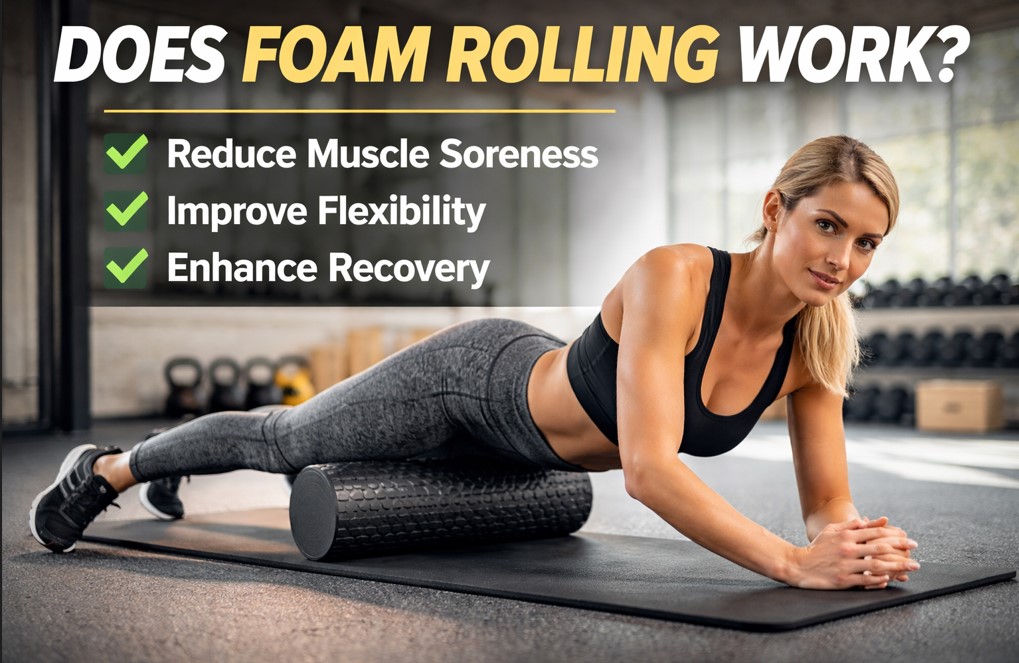
Walk into any gym today and you’ll see someone lying on the floor, slowly rolling their thighs over a cylindrical foam tube with a slightly painful expression. Foam rolling has become a staple in fitness routines — from beginners to elite athletes.
But the real question is: does foam rolling work, or is it just another fitness trend that looks good on Instagram?
Let’s break it down with evidence, not hype.
What Is Foam Rolling?
Foam rolling is a form of self-myofascial release (SMR). In simple words, it’s a self-massage technique where you use your body weight on a foam roller to apply pressure to muscles and fascia (the connective tissue surrounding muscles).
The idea is to:
- Reduce muscle tightness
- Improve mobility
- Enhance recovery
- Decrease soreness
Sounds impressive. But what does science say?
Does Foam Rolling Work?
The short answer: Yes — but with limits.
Research over the past decade shows that foam rolling does provide measurable benefits, especially for flexibility and short-term recovery. However, it’s not a miracle cure for muscle pain or performance enhancement.
Let’s examine what evidence supports.
1️⃣ Improves Flexibility and Range of Motion
One of the most consistently supported benefits of foam roller use is increased range of motion (ROM).
Multiple studies show that rolling for 30–90 seconds per muscle group can increase flexibility without negatively affecting muscle strength. This is important because traditional static stretching before workouts can sometimes reduce power output.
Foam rolling, on the other hand:
- Improves ankle mobility
- Enhances hip range
- Increases hamstring flexibility
- Does NOT significantly reduce strength
This makes it a useful tool during warm-ups.
✔ Evidence-based takeaway: Foam rolling works well for short-term mobility improvements.
2️⃣ Reduces Delayed Onset Muscle Soreness (DOMS)
We’ve all felt that post-leg-day pain. That stiffness 24–48 hours later is called DOMS.
Studies suggest foam rolling after exercise can:
- Reduce perceived muscle soreness
- Improve comfort levels
- Help you return to training sooner
However, it’s important to note something crucial:
Foam rolling may not “repair” muscle damage faster — it mainly reduces the perception of soreness.
This likely happens through:
- Increased blood flow
- Nervous system modulation
- Pain threshold changes
✔ Evidence-based takeaway: Foam rolling helps you feel better, even if it doesn’t fully speed tissue healing.
3️⃣ Does It Break Up “Knots” or Fascia?
This is where marketing often exaggerates.
Many claims suggest foam rolling:
- Breaks up adhesions
- Reshapes fascia
- Releases scar tissue
Current evidence does NOT strongly support the idea that you are mechanically breaking down fascia with a foam roller. The pressure applied simply isn’t enough to structurally alter deep tissue.
Instead, improvements likely occur due to:
- Neurological relaxation
- Temporary reduction in muscle tone
- Increased stretch tolerance
✔ Evidence-based takeaway: Foam rolling changes how your nervous system perceives tightness — not the physical structure of fascia.
4️⃣ Does Foam Rolling Improve Performance?
If you’re wondering, “Does foam rolling make me stronger or faster?” — the answer is: not directly.
Research shows:
- No major strength gains
- No major speed improvements
- No long-term performance enhancement
However, if foam rolling helps you:
- Move better
- Warm up effectively
- Reduce soreness
Then indirectly, it may support better training consistency — which ultimately improves performance.
5️⃣ When Foam Rolling Is Most Useful
Foam rolling is most effective when used strategically.
Before Workout:
- 30–60 seconds per muscle group
- Focus on tight areas
- Combine with dynamic warm-up
After Workout:
- Gentle rolling
- 60–90 seconds per muscle
- Focus on sore areas
For Sedentary Individuals:
If you sit long hours (which many professionals and students do), foam rolling the hip flexors, calves, and thoracic spine can temporarily relieve stiffness.
Who Should Be Careful?
Foam rolling is generally safe, but avoid it if:
- You have acute injuries
- There is swelling or inflammation
- You have fractures
- You have certain vascular conditions
Pain during rolling should be uncomfortable but tolerable — not sharp or unbearable.
More pressure does NOT mean better results.
Is Foam Rolling Just a Trend?
No — but it’s also not magic.
It became trendy because:
- It’s affordable
- It’s simple
- It feels productive
- Athletes promote it
But unlike many fitness fads, foam rolling has moderate scientific support.
It works best as:
- A warm-up tool
- A mobility enhancer
- A soreness management strategy
It does NOT:
- Replace proper strength training
- Cure chronic pain
- Permanently fix posture
- “Detox” muscles
The Real Benefits of Foam Roller (Summary)
Here’s what we can confidently say:
✔ Improves short-term flexibility
✔ Reduces perceived muscle soreness
✔ Enhances mobility before workouts
✔ Supports recovery routine
And what it does NOT do:
✘ Break up scar tissue
✘ Permanently reshape fascia
✘ Dramatically boost strength